
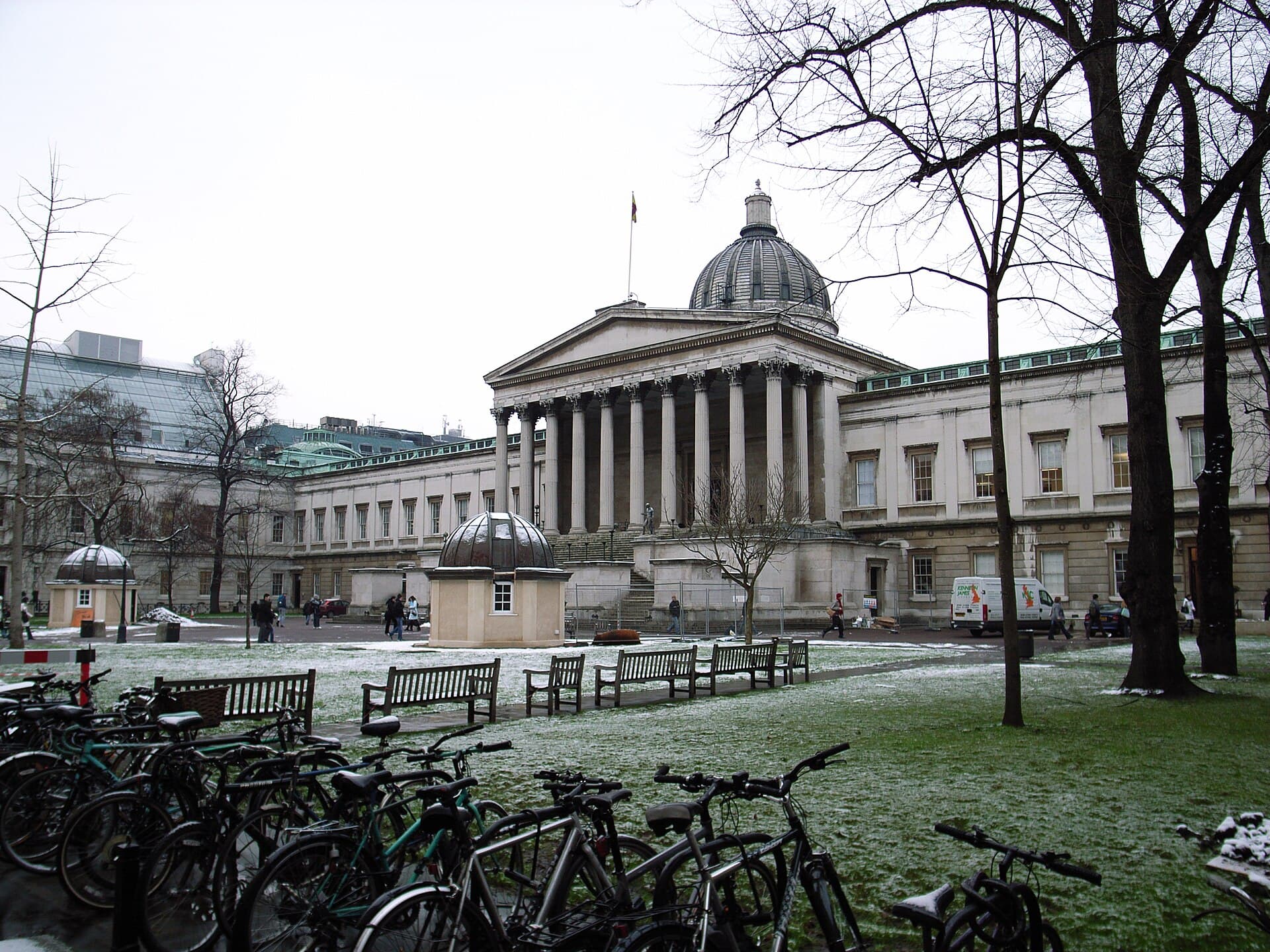
University College London (UCL)
University College London is a public university founded in 1826 and based in the Bloomsbury district of London. It teaches across eleven faculties, is a member of the Russell Group and takes undergraduate applications through UCAS.
2-minute form · free · no sign-up
One record matters more than any ranking when reading a university page: the Home Office register of student sponsors, which is what permits an institution to issue the CAS a student visa requires. University College London (UCL) appears on it, and on the register that carries degree-awarding powers; this page sets out the institution’s subjects, entry requirements, fee arrangements and application steps.
01
What kind of university is UCL?
UCL is a public university founded in 1826 and based in the Bloomsbury district of London. It teaches across eleven faculties, from engineering to art history, and is among the largest institutions in England by number of enrolled students.
The faculties include engineering sciences, arts and humanities, brain sciences, life sciences, medical sciences, mathematical and physical sciences, laws, education and society, the built environment at the Bartlett, and social and historical sciences. That breadth also raises the number of interdisciplinary courses on offer.
Degree-awarding powers sit on the Office for Students register; the authority to issue the CAS a student visa requires sits on the Home Office register of licensed sponsors. The two registers are kept separately and both are recorded in the institution's own name.
02
Which subjects stand out at UCL?
Architecture and planning run under the Bartlett and are among the best known parts of the institution. Alongside them, medicine, neuroscience, computer science, law, economics and education carry long course lists at undergraduate and postgraduate level.
- The Bartlett: architecture, urban planning, construction management, urban design.
- Engineering Sciences: computer science, mechanical, chemical, biomedical engineering.
- Medicine and Brain Sciences: medicine, neuroscience, psychology, ear institute research.
- Social Sciences: law, economics, politics, anthropology, education at the IOE.
Education runs through the Institute of Education, which joined the institution in 2014 and is among the best known units in its field internationally. Course lists are published separately at undergraduate and postgraduate level.
03
What are the entry requirements at UCL?
For postgraduate entry the institution publishes a GPA of 3.3 out of 4, or 80 per cent, as the 2:1 equivalent on a Turkish degree, and 3.0 or 75 per cent as the 2:2 equivalent. A school diploma is not sufficient.
| Level | Published threshold |
|---|---|
| Postgraduate — courses asking a 2:1 | Turkish bachelor's degree, 3.3 out of 4 or 80 per cent |
| Postgraduate — courses asking a 2:2 | Turkish bachelor's degree, 3.0 out of 4 or 75 per cent |
| Undergraduate — one year of a Turkish degree | First year of a bachelor's degree, at least 3.3 out of 4 |
| Undergraduate — with a school diploma | A-level, IB or the UPC foundation year |
The English language requirement is published separately on the course page. The institution's own preparatory route for school leavers is the Undergraduate Preparatory Certificate; the general arrangement is set out on the foundation programmes page.
04
What are tuition fees at UCL?
The international fee varies by course and each course publishes the figure on its own page. The institution runs scholarships at undergraduate and postgraduate level; conditions and deadlines are listed on its funding pages by year of entry and by course.
Alongside tuition, living cost is the second large item. The maintenance funds a student visa asks you to show are set by region and come to £1,529 a month here; outside London the same line is £1,171.
Postgraduate scholarships also run at department level and their deadlines close before the course's own. The UK scholarships page sets out the arrangement in general terms.
Free starter report
Let us draw up your free starter report
Seven short questions, one tap each. In return you get a costed sheet worked out from how many people are coming, what scale you are looking at and whether it is London — alongside the steps in months, the documents and the published rules.
05
What is the campus and student life like in London?
The main site is in Bloomsbury, in the same neighbourhood as the British Museum, with buildings spread over several streets. The institution also runs UCL East in the east of the city; the two areas connect by underground and the Elizabeth line.
Bloomsbury is a district where university libraries and museums concentrate; the British Museum and the British Library are within walking distance. UCL East sits inside the Queen Elizabeth Olympic Park and has opened in stages since 2022.
Rent in London runs markedly above the England average and that gap is the largest variable in a budget. Student accommodation sits largely outside the centre and connects to the campuses by public transport.
06
How do you apply to UCL?
Undergraduate applications go through UCAS; the deadline for 2027 entry is 13 January 2027, and 15 October 2026 for medicine. Postgraduate and doctoral applications are sent directly to the course through the institution's own online portal.
- Choose the course and read its own entry requirements section.
- Send the UCAS application by 13 January 2027 for undergraduate entry, and by 15 October 2026 for medicine.
- For postgraduate study apply through the institution’s own portal, uploading transcripts and references.
- If an offer is made, meet the academic and English language conditions.
- Once the conditions are met a CAS is issued and the student visa application follows.
British Global supplies information at this stage and, where it is wanted, introduces a firm whose authorisation has been verified on a register; assessing a visa application belongs to an IAA-registered or SRA-authorised adviser.
07
Frequently asked questions
Can you apply to UCL with a Turkish high school diploma alone?
A school diploma is not sufficient on its own. The institution publishes accepted qualifications such as A-levels and the IB, along with its own Undergraduate Preparatory Certificate; course pages list what is accepted.
I started university in Turkey — can I transfer to an undergraduate course?
The institution considers applicants who have completed the first year of an undergraduate programme at a Turkish university it recognises with at least 3.3 out of 4. Additional course-level conditions are published separately.
What grade is published for postgraduate entry?
Courses asking a 2:1 publish 3.3 out of 4 or 80 per cent on a Turkish bachelor's degree; courses asking a 2:2 publish 3.0 or 75 per cent. Departments ask for more than the minimum.
How much maintenance is shown for London?
A student visa asks for £1,529 a month in London and £1,171 outside it. The amount is calculated for up to nine months and is a separate line from tuition.
Sources
- UCL — Turkey — Thresholds published for Turkish degrees: 3.3/4 or 80% as a 2:1, 3.0/4 or 75% as a 2:2, and 3.3 on a completed first year — checked 25 August 2026
- UCL — Graduate entry requirements — The 2:1 and 2:2 distinction in postgraduate admission and the master's requirement on doctoral programmes — checked 25 August 2026
- UCAS — The 2027 entry timetable, the five-choice limit and the 13 January 2027 equal consideration date — checked 25 August 2026
- GOV.UK — Student visa — Student visa fee, healthcare surcharge and the maintenance funds to be shown — checked 25 August 2026
