
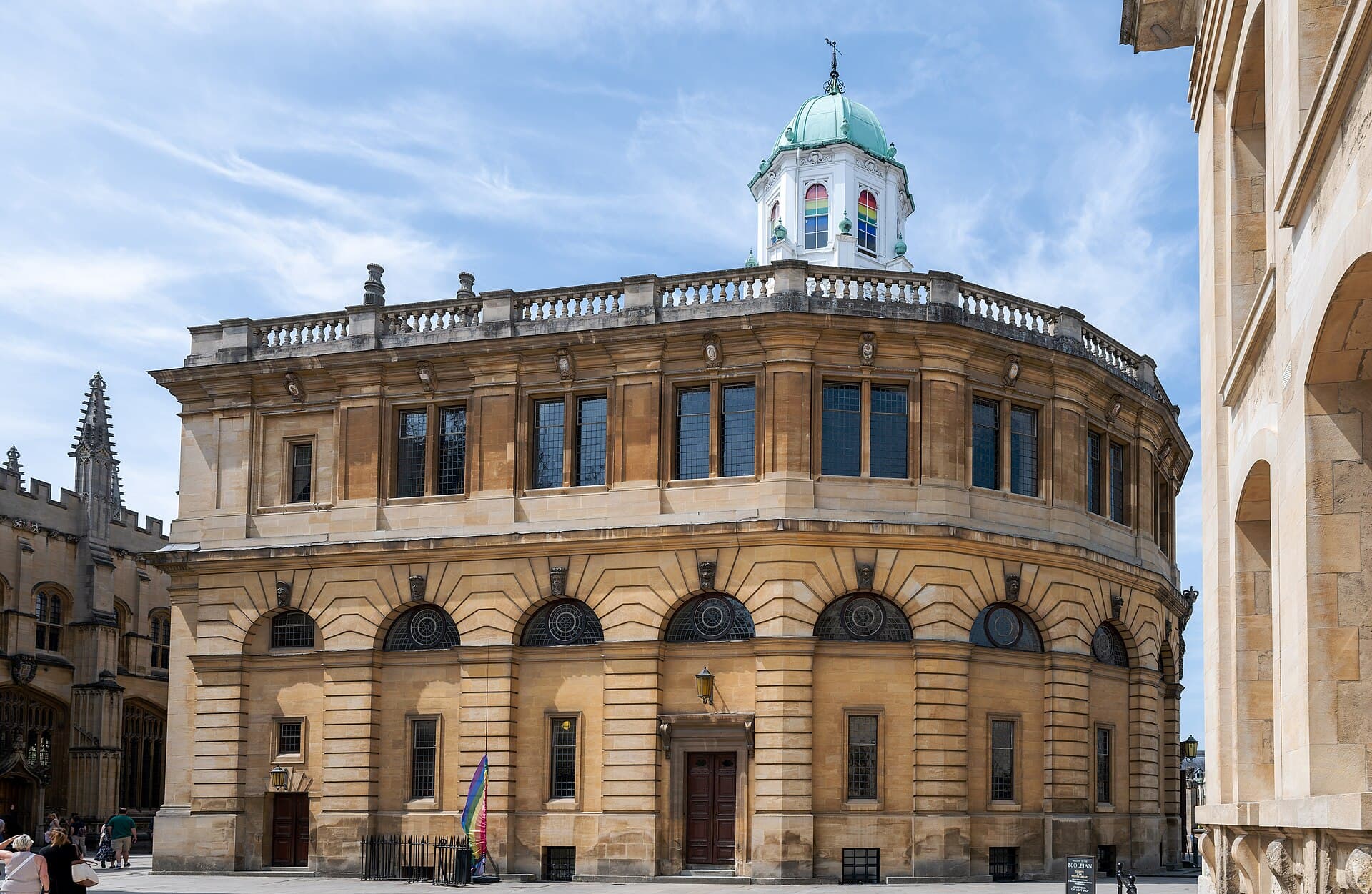
University of Oxford
The University of Oxford is a public university where teaching is recorded from 1096, making it the oldest in the English-speaking world, and it is organised around colleges. Undergraduate applications go through UCAS with a 15 October deadline, followed by interviews.
2-minute form · free · no sign-up
One record matters more than any ranking when reading a university page: the Home Office register of student sponsors, which is what permits an institution to issue the CAS a student visa requires. University of Oxford appears on it, and on the register that carries degree-awarding powers; this page sets out the institution’s subjects, entry requirements, fee arrangements and application steps.
01
What kind of university is Oxford?
The University of Oxford is a public university where teaching is recorded from 1096, and it is organised around colleges. Every student belongs both to the university and to a college; lectures and examinations sit with departments, while weekly small-group teaching sits with the college.
The collegiate system is the structure that governs daily life here. Departments run the lectures, examinations and laboratories; colleges take on accommodation, dining and the weekly one-to-one or pair teaching. An applicant may name a college or leave an open preference and be allocated one.
Degree-awarding powers sit on the Office for Students register; the authority to issue the CAS a student visa requires sits on the Home Office register of licensed sponsors. The two registers are kept separately and both are recorded in the institution's own name.
02
Which subjects stand out at Oxford?
The university divides into four divisions: humanities, mathematical, physical and life sciences, medical sciences, and social sciences. Law, philosophy, politics and economics, medicine, mathematics and engineering science are among the best known undergraduate and postgraduate titles it publishes.
- Humanities: history, philosophy, languages and literature, theology, music.
- Mathematical, Physical and Life Sciences: mathematics, computer science, engineering science, biology.
- Medical Sciences: medicine, biochemistry, pharmacology, neuroscience.
- Social Sciences: law, economics, politics, business at the Saïd Business School.
The undergraduate list is deliberately narrow and each title publishes its own admission requirements, its own interview arrangement and any admissions test it sets. Combined degrees such as philosophy, politics and economics are particular to Oxford and run across more than one faculty.
03
What are the entry requirements at Oxford?
Undergraduate admission rests on A-levels, the IB or another accepted equivalent; a Turkish high school diploma is not sufficient on its own. For courses asking a strong 2:1 the institution publishes an overall GPA of 3.3 out of 4 on a Turkish degree.
| Level | Published threshold |
|---|---|
| Undergraduate | A-level, IB or another accepted equivalent qualification |
| Postgraduate — courses asking a strong 2:1 | Turkish bachelor's degree, GPA 3.3 out of 4 |
| Postgraduate — courses asking a first | Turkish bachelor's degree, GPA 3.6 out of 4 |
The English language requirement is published separately on the course page. For an applicant holding a Turkish high school diploma the usual route is an accepted qualification such as A-level or the IB, or one of the foundation programmes.
04
What are tuition fees at Oxford?
The international fee varies by course and each course publishes the figure on its own page. Undergraduate study carries a college fee in addition to tuition; scholarships and support schemes are listed on the institution's funding pages by year of entry.
Alongside tuition, living cost is the second large item. The maintenance funds a student visa asks you to show are set by region and come to £1,171 a month here; in London the same line is £1,529.
Postgraduate scholarships also run at department level and their deadlines close before the course's own. The UK scholarships page sets out the arrangement in general terms.
Free starter report
Let us draw up your free starter report
Seven short questions, one tap each. In return you get a costed sheet worked out from how many people are coming, what scale you are looking at and whether it is London — alongside the steps in months, the documents and the published rules.
05
What is the campus and student life like in Oxford?
Oxford has no single campus; colleges, libraries and departments are spread across the city centre. The Bodleian libraries, the university museums and college dining halls sit at the centre of daily life, and short distances make the city one crossed on foot or by bicycle.
The city sits about an hour from London by train and airport connections run by coach. Accommodation is mostly in college rooms in the early years; later on students move into rented housing in the city.
The academic year runs over three terms and each term is eight weeks long. That differs from the two-semester pattern common in England and compresses reading and assessment into short intervals.
06
How do you apply to Oxford?
Undergraduate applications go through UCAS and the deadline for 2027 entry is 15 October 2026, three months ahead of the general timetable. Postgraduate and doctoral applications are sent directly to the course through the university's own portal.
- Choose the course and either name a college or leave an open preference.
- Send the UCAS application by 15 October 2026 — that is the date for 2027 entry.
- Register for and sit any admissions test the course sets.
- Shortlisted applicants are called to interview in December.
- If an offer is made and its conditions are met, a CAS is issued and the visa application follows.
Oxford and Cambridge cannot both be chosen in the same application year; UCAS applies that restriction at system level.
British Global supplies information at this stage and, where it is wanted, introduces a firm whose authorisation has been verified on a register; assessing a visa application belongs to an IAA-registered or SRA-authorised adviser.
07
Frequently asked questions
Can you apply to Oxford with a Turkish high school diploma alone?
A Turkish high school diploma is not sufficient on its own for an undergraduate application. Applicants hold an accepted qualification such as A-levels or the IB, or complete a foundation year; the international qualifications page lists what is accepted.
Can you apply to Oxford and Cambridge at once?
No. UCAS does not allow both universities to be chosen in the same application year and the applicant picks one. Choices are also limited on medicine and veterinary courses.
Why is the deadline 15 October?
Oxford, Cambridge and most medicine, dentistry and veterinary courses sit on the early UCAS deadline. For 2027 entry that date is 15 October 2026; every other course has 13 January 2027.
What grade is published for postgraduate entry?
For courses asking a strong 2:1 the institution publishes a GPA of 3.3 out of 4 on a Turkish bachelor's degree, and 3.6 for courses asking a first. Departments ask for more and meeting the minimum is not an offer.
Sources
- University of Oxford — International qualifications — Thresholds published for Turkish degrees: GPA 3.3/4 for a strong 2:1 and 3.6/4 for a first — checked 25 August 2026
- University of Oxford — International students — Undergraduate admission arrangements for international applicants, accepted qualifications and the interview stage — checked 25 August 2026
- UCAS — The 2027 entry timetable, the five-choice limit and the 13 January 2027 equal consideration date — checked 25 August 2026
- GOV.UK — Student visa — Student visa fee, healthcare surcharge and the maintenance funds to be shown — checked 25 August 2026
